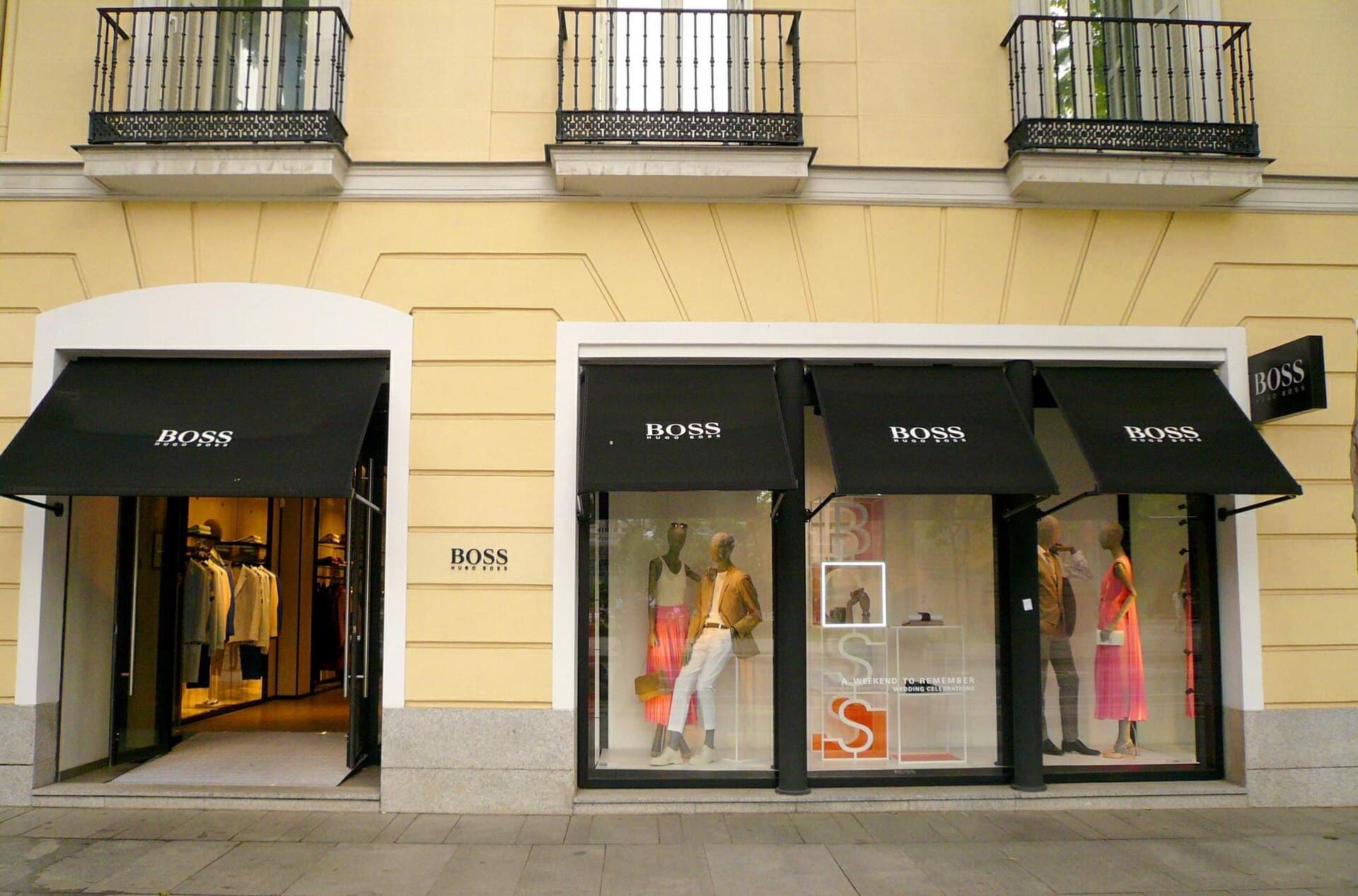
At 23:11 on Monday night, Central European time, Hugo Boss published the kind of release that lands after one market close and before the next open. It cut its outlook for 2026. Group sales are now expected to fall by a high single-digit percentage on a currency-adjusted basis, where the previous range was mid to high single digits, and operating profit (EBIT) is now guided to €250 million to €300 million, down from €300 million to €350 million, as stated in the company's ad hoc release. The full third-quarter report follows today.
It is the first warning Hugo Boss has issued since it stopped being an independent company. Ten days earlier, on Friday October 23, Frasers Group took its stake above 50%.
The quarter
Third-quarter revenue was €946 million, down 4% as reported and 5% currency-adjusted, from €989 million a year earlier. EBIT fell to €81 million, an 8.6% margin, from €95 million and 9.6%. The company put the sales decline down to "the ongoing strategic realignment of the Company's business under CLAIM 5 TOUCHDOWN as well as subdued consumer demand across key markets," according to the release.
Two lines in the same release point the other way. Gross margin rose 220 basis points to 63.3%, on sourcing efficiencies and what Hugo Boss calls optimized pricing, while operating expenses grew 2%. Read together, that is a house selling fewer clothes at a better margin each, and spending more to do it. It is a defensible trade. It is also what a brand looks like when it chooses to be smaller before the market chooses for it.
Analysts were not caught out on sales. They had expected a currency-adjusted decline of 8% for the year and a sharper fall in the quarter than the one reported, according to a Bloomberg consensus cited by dpa-AFX. The surprise is the profit line. The same consensus had EBIT at a little over €300 million, the floor of the old range. The new range now ends there. Against €391 million in 2025, as dpa-AFX reported, the midpoint of the new guidance is a fall of about 30%.
The reason nobody expected
Hugo Boss gave two reasons for the lower profit. One is familiar: "softer consumer demand assumptions." The other is not. The cut reflects "higher non-cash depreciation and amortization expenses for IT assets, given rapidly evolving AI and technology developments," the release says.
That is a careful way of saying that technology the company bought recently is ageing faster than planned and has to be written down sooner. It costs no cash, and in that sense it flatters the problem less than it appears to. But it is a striking sentence to find in a fashion company's profit warning, and it will not be the last. Every house that spent the last three years digitizing its supply chain and its stores is carrying the same kind of asset on its books.
The buyer owns the brand now
What makes this warning different is who receives it. Frasers bought 198,666 shares for about €7.6 million on October 23 and now holds 50.08%, roughly 34.5 million shares, which makes Hugo Boss a subsidiary whose earnings, assets and liabilities it consolidates, as reported by FashionUnited. It got there without a deal. In June it offered €38 a share for the rest of the company, a bid worth about €2 billion that both Hugo Boss boards rejected as "financially inadequate," as reported by Katie Searles for Retail Gazette. Frasers then bought its way past half anyway, from 26.06% to 47.89% by August and to 48.8% in a filing on October 19, according to FashionUnited.
The boardroom had already moved before the threshold did. Supervisory board chairman Stephan Sturm stepped down and Frasers' Michael Murray was elected chairman in September; chief financial officer Yves Müller left, and Ivica Maric became finance and operations chief on October 1, FashionUnited reported. Hugo Boss said crossing 50% "would not have any major implications for the business," Retail Gazette reported. Monday night's release is the first test of that sentence.
Here is the part that matters for the clothes. Frasers is a retailer before it is anything else. Its new luxury division puts Flannels, Harvey Nichols and The Webster together, with revenue above £1 billion, alongside stakes in Mulberry and Burberry, as reported by FashionUnited and by Jade Burke for Drapers. A house that used to sell to department stores now belongs to one. The wholesale buyer and the owner sit at the same table.
That can go two ways. It can give BOSS what most brands of its size never get, a guaranteed shelf and a buyer who wants it to work. Or it can turn a house with its own runway into a private label with a famous name, designed for the floor plan of the stores that carry it. Last week we wrote that at Gucci the buyers believe in the brand before the customers do. At Hugo Boss the buyer no longer needs convincing, which removes the one test that used to tell a house whether its collections were landing.
What to watch
Three things. Whether today's full report breaks down BOSS against HUGO and wholesale against the company's own stores, because a retailer-owner will want to see the second split above all. Whether Frasers says anything about the listing, which its announcement of October 23 did not address. And whether the depreciation sentence spreads: the luxury groups reporting this quarter blamed China and traffic. Hugo Boss is the first we have seen point at its own technology.
Third-quarter figures, guidance, the CLAIM 5 TOUCHDOWN and IT depreciation explanations and the capital expenditure update as stated in Hugo Boss's ad hoc release of November 2, 2026. Consensus figures and 2025 EBIT as reported by dpa-AFX (November 2, 2026). Frasers' share purchase, stake history, governance changes and luxury division as reported by FashionUnited (October 2026). The June offer and Hugo Boss's response as reported by Katie Searles for Retail Gazette (October 26, 2026). Frasers Group Luxury holdings as reported by Jade Burke for Drapers (October 26, 2026).